 Napier
 liquidity pools link LP fee income to trading activity and pool settings
Napier liquidity pools pair a Principal Token (PT) with its underlying yield-bearing asset and allocate trading fees under market-specific rules. LP returns can also include PT appreciation toward maturity and yield from the underlying asset. Within Napier AMM, the native automated market maker, curator-set splits determine the portion liquidity providers (LPs) share. Each provider's liquidity share then determines its allocation. Some pools also deploy idle assets into external vaults, adding yield and a withdrawal dependency. Curve-backed pools follow a different trading curve and pool fee configuration. Choosing a pool therefore involves its fee allocation, useful trading depth, additional exposures, and exit assets. The deposit route also determines whether a separate Yield Token (YT) balance remains alongside the LP position.
Bottom line: A provider's percentage can change when pool liquidity changes, even if the fee split remains fixed.
Liquidity quotes and blocked deposits
The Napier app presents deposit actions and estimates in the selected market's Liquidity tab. Its estimate shows pool share, charges, and minimum received. The underlying asset, maturity, and AMM identify the position the deposit will create. Another market using the same asset can carry different terms.
Unavailable vault withdrawals can make a deposit revert when its liquidity route needs those assets. Increasing slippage tolerance cannot release those assets. A changed quote needs a fresh estimate; a withdrawal failure needs restored access to the required liquidity. Repeated submissions do not establish whether either condition has changed.
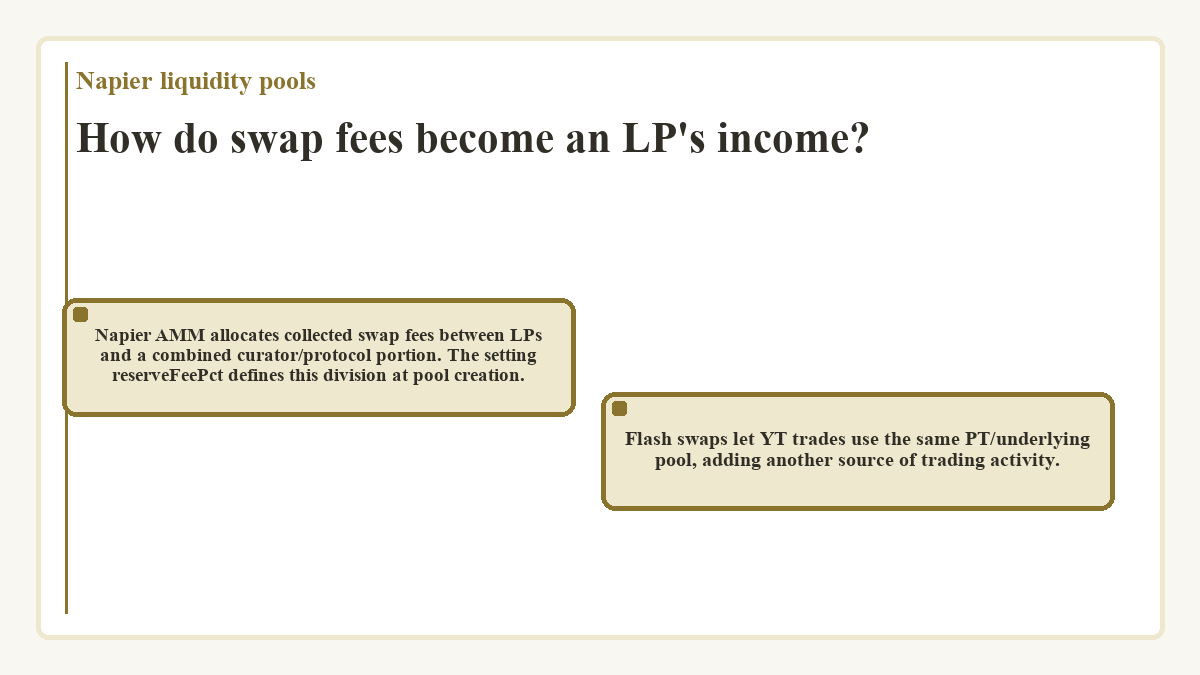
How do swap fees become an LP's income?
Napier AMM allocates collected swap fees between LPs and a combined curator/protocol portion. The setting
reserveFeePct
defines this division at pool creation. Flash swaps let YT trades use the same PT/underlying pool, adding another source of trading activity.
Allocation within the pool
LP portion
LPs share their allocated swap fees in proportion to their liquidity. A provider's percentage applies to this LP portion after the pool-level split.
Curator and protocol portion
Napier Governance controls
splitFeePct
, which divides the remaining allocation between curator and protocol. This second division changes the recipients of that portion. It does not change an LP allocation already determined by the first split.
Fee bases change the value of a quoted percentage
Napier AMM applies its swap charge to the yield-receivable portion of PT, denominated in the underlying token. Remaining time to maturity therefore affects that fee base. Applying the displayed percentage to the full trade balance would ignore this distinction. Curve-backed markets require their own pool fee configuration; the native fee basis cannot automatically describe their charges. Meaningful comparisons use the effective charge on the intended action and the share LPs retain. Fee income also needs a measurement period: an allocation of collected fees alone does not establish an annual return.
A fee allocation reconciled with accrued revenue
Accrued swap-fee records must cover the same interval as the provider's liquidity share. A deposit balance alone cannot establish fee income.
In this hypothetical Napier AMM case, a pool accrues 246 underlying-token units in swap fees during an interval. Its LP allocation is 73%, and a provider holds 8% of the pool's liquidity throughout that interval.
The LP portion equals 246 × 0.73 = 179.58 underlying-token units. The provider's fee allocation equals 179.58 × 0.08 = 14.3664 underlying-token units before rounding and costs. Changing the LP allocation changes the amount shared; changing the provider's share changes its portion.
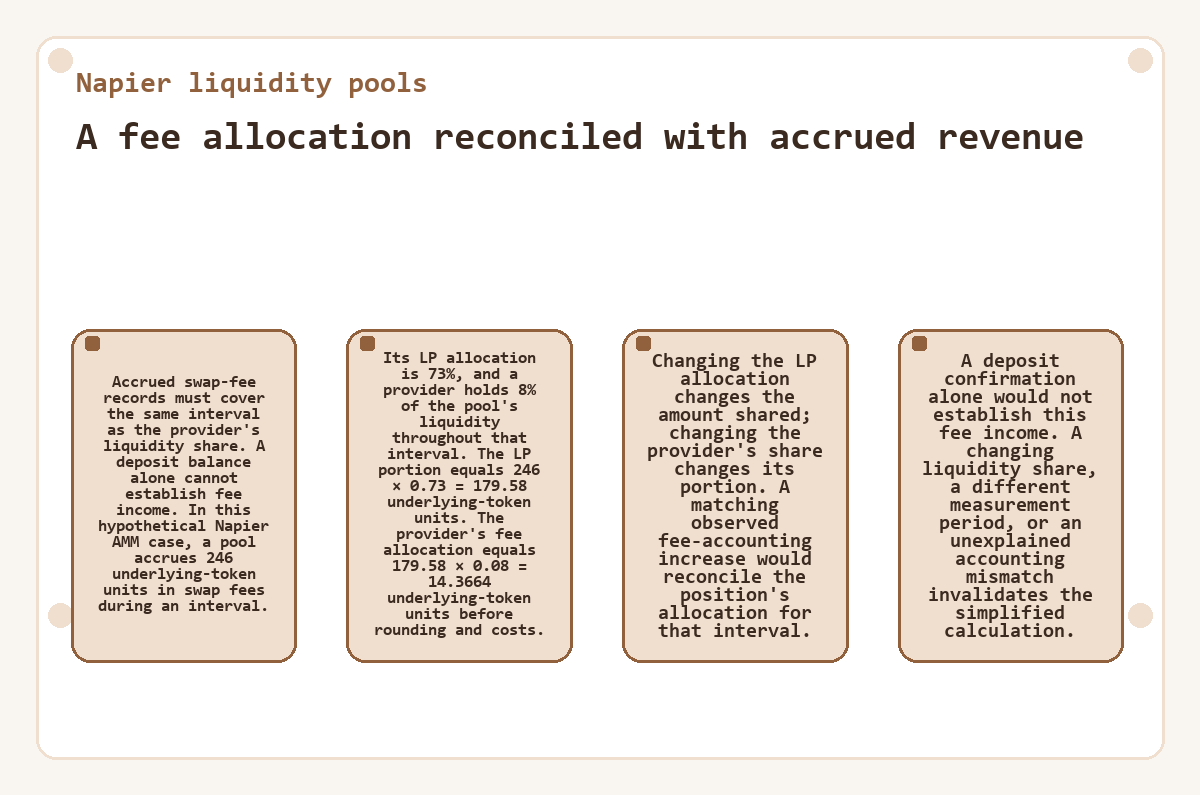
A matching observed fee-accounting increase would reconcile the position's allocation for that interval. A deposit confirmation alone would not establish this fee income. A changing liquidity share, a different measurement period, or an unexplained accounting mismatch invalidates the simplified calculation.
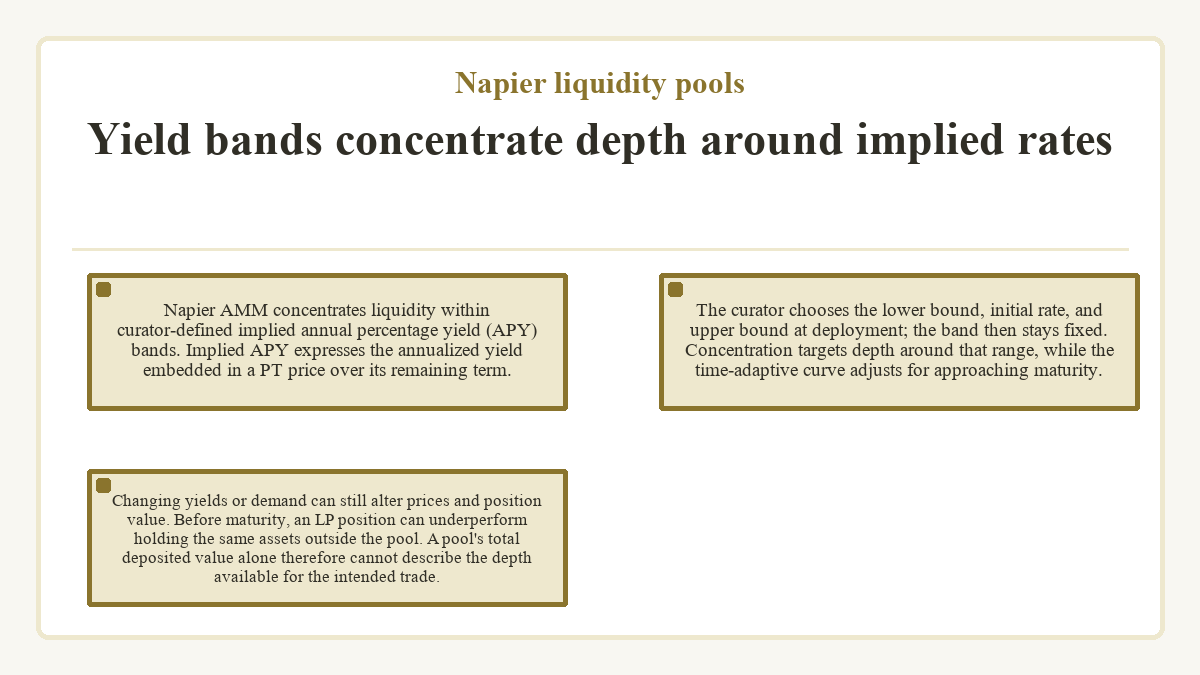
Yield bands concentrate depth around implied rates
Napier AMM concentrates liquidity within curator-defined implied annual percentage yield (APY) bands. Implied APY expresses the annualized yield embedded in a PT price over its remaining term. The curator chooses the lower bound, initial rate, and upper bound at deployment; the band then stays fixed. Concentration targets depth around that range, while the time-adaptive curve adjusts for approaching maturity. Changing yields or demand can still alter prices and position value. Before maturity, an LP position can underperform holding the same assets outside the pool. A pool's total deposited value alone therefore cannot describe the depth available for the intended trade.
Does rehypothecation preserve immediate swap liquidity?
Rehypothecated assets can support swaps when their destination vault releases the needed tokens during execution. Rehypothecation allocates idle pool assets to external vaults, including compatible ERC-4626 vaults. ERC-4626 standardizes tokenized vault shares. Additional returns come from those vaults' activity, alongside the pool's trading fees. The selected vault becomes another source of liquidity and loss exposure.
Raw-token buffers
The Min, Max, and Target settings describe raw-token balances relative to total balances for the allocated assets. Raw tokens remain outside the external vault. Setting every ratio to 100% leaves no allocation to rehypothecation. Curators choose destination vaults and allocations for PT and underlying assets separately. The same pool can therefore carry different dependencies on each side.
Withdrawals inside execution
A trade requiring allocated tokens can revert if the external vault cannot release them during execution. Atomic withdrawal, use, and resupply add gas costs when the route needs those operations. Vault insolvency introduces a separate loss risk even when historical fee income looks attractive. A raw-token buffer can reduce reliance on immediate vault access without eliminating the vault exposure.
Pool engines create different exposure choices
Curve's Two-Crypto-NG places liquidity across its full trading curve, removing the need to choose an implied-APY band. Napier AMM uses maturity-aware pricing and a concentrated range. Both serve PT/underlying markets, while their liquidity placement changes the reserves available at different prices. Curve's invariant targets correlated assets with some volatility, matching the relationship between PT and its underlying.
TokiHook implements Napier's maturity-aware AMM as a Uniswap v4 Hook. The native AMM configuration supports rehypothecation, while the documented Curve-backed model does not. A native pool can connect trading reserves with compatible vault allocations. Compare those external dependencies alongside liquidity placement and fee allocation; the shared PT/underlying structure does not create identical LP exposure.
Optional rewards depend on the eligible balance
Partner points can apply to the entire LP position or only its non-PT portion, depending on the program operator's rules. The integration measures underlying-token exposure on a specified chain at a snapshot block. Its sample LP output covers the non-PT portion. Using that output for a whole-LP policy would omit the PT portion. Points remain distinct from fees denominated in the underlying token, and the pool balance alone does not establish a points award. A reward projection therefore needs the program's allocation policy as well as the eligible exposure.
Retained permissions affect ongoing pool conditions
Curators control delegated market roles and any settings the market leaves adjustable. An enabled rehypothecation lock prevents further changes to destination vaults and allocation ratios. The lock preserves the chosen allocation policy; it does not ensure a destination vault remains solvent or liquid. Smart-contract risks also remain in the pool and any external vault.
An authorized Protocol Pauser can pause specific market functions during an emergency. A pause takes effect immediately and can affect trading behavior and price formation. Its effect depends on the functions the market disables, so a pause does not establish a universal exit rule. LP income and access remain subject to both pool activity and the functions available in that state.
Exit assets determine the remaining price exposure
Withdraw (Exit) returns PT and underlying assets at the pool's current ratio. Withdraw (Swap & Exit) targets underlying assets alone. Before maturity, the latter includes selling PT and therefore introduces sale-price impact. After maturity, that route reclaims the underlying from PT. These output choices leave different holdings, even when both begin with the same LP balance.
Positive fee income does not cancel a fall in the value of the assets an exit returns. Shallow liquidity can also affect PT sales. A retained PT balance keeps its fixed-yield maturity exposure. Redeeming LP tokens alone does not sell a separately retained YT balance from Deposit (Mint & LP).
Napier liquidity pools questions, answered
Can I retain YT while adding liquidity to Napier?
Deposit (Mint & LP) leaves YT alongside the LP tokens after minting PT and YT and supplying PT with the underlying. Deposit (Swap & LP) sells the minted YT for PT before supplying liquidity, leaving LP tokens only. That sale introduces price impact, so the two deposit routes create different holdings and execution costs.
Does LP swap-fee income require a separate claim?
LP swap-fee income compounds automatically within the liquidity position. Curator fee collection is a separate operation for its designated recipient. Automatic compounding does not imply a wallet payment after every trade, and the compounded fee component remains exposed to the pool's asset and execution risks.
Who receives the curator allocation from a Napier pool?
The curator assigns the Fee Receiver role to collect curation fees. The Curator Dashboard requires the appropriate fee-collection permission before a claim. Owning LP liquidity provides an entitlement to the LP allocation without automatically granting authority to collect the curator's revenue.
Do blockchain network charges become income for Napier LPs?
Network charges pay for transaction execution, while LP revenue comes from the pool's allocated fees. The deposit estimate separates network cost from the percentage-based protocol charge. A larger network bill therefore does not establish greater pool revenue, and it remains a cost when evaluating a deposit or withdrawal.
Can a Curve-backed Napier pool earn gauge rewards?
A Curve-backed Napier pool can earn additional gauge incentives when the necessary gauge and reward arrangements apply. Curve's ecosystem supports gauges and veCRV incentives alongside trading fees. Those mechanisms require their own configuration and allocation. Additional incentives can vary independently of the pool's trading fees.
Is there a minimum initial deposit for launching a Napier AMM pool?
Napier AMM has no minimum initial deposit requirement for pool creation. The creation flow still includes an initial-liquidity allocation and pairs the underlying with PT. This launch rule does not establish how much liquidity supports a particular trade size. Available depth and price impact remain properties of the actual pool state.
When does partner-points tracking end for a maturing Napier pool?
The partner-points integration stops tracking a market after maturity, when YT stops accruing yield. This cutoff concerns that integration's exposure tracking. It does not determine an LP's swap-fee allocation or prove every external incentive follows the same schedule. Separate reward arrangements retain their own eligibility and timing rules.