 Napier
 connects yield trading with market management and integration infrastructure
Napier brings yield trading, market management, and integration tools together around tokenized fixed income markets. Its non-custodial protocol enables yield creation, tokenization, and trading on Ethereum and layer 2 networks. Markets covers fixed and variable yield exposure through Principal Tokens (PT) and Yield Tokens (YT). Prime provides market management, and Infra supports integration and distribution. Available products and individual markets have their own access conditions and economic terms.
Key takeaway: Market-specific maturity, permissions, and fee settings shape yield products, even when they share the same trading and integration infrastructure.
Markets, Prime, and Infra serve different functions
The main difference is whether a product provides trading access, configures a market, or connects an external application. Yield Trading presents PT and YT markets. Curate handles parameter choices and market operation within Prime. The application programming interface (API) exposes market, token, and protocol data through Infra. These functions meet around the same markets: an issuer supplies an eligible asset, an operator organizes liquidity, and a distributor connects trading demand.
How do PT and YT change yield exposure?
Yield tokenization separates a yield-bearing asset into a principal claim and a claim on yield. PT and YT share an underlying asset and maturity, while exposing holders to different sources of return.
Principal and yield claims
PT carries the principal claim associated with maturity; buying at a discount creates fixed yield exposure when held to maturity, subject to the market's redemption terms. Selling earlier exposes the proceeds to the trading price and available liquidity. The purchase price and fees affect the effective yield.
YT carries the right to yield during the applicable accrual period, with returns depending on underlying yield and purchase price. YT stops accruing yield at maturity, although yield-bearing tokens backing matured, unredeemed PT can continue generating yield.
Trading pools and AMM choices
Trading pools pair PT with its underlying yield-bearing asset. An automated market maker (AMM) supplies the pricing mechanism, while an execution router can combine issuance, swaps, and liquidity actions atomically. TokiHook implements the native AMM as a Uniswap v4 Hook, incorporating time to maturity and implied yields into pricing. Concentrated liquidity focuses capital within implied annual percentage yield (APY) bands.
Native AMM configurations can deploy liquidity-provider capital into ERC-4626 vaults, a mechanism called rehypothecation. Dynamic pool and vault rebalancing supplies just-in-time liquidity during trades. Curve-based markets use Two-Crypto-NG and spread liquidity across the full curve without implied-APY bands. Both pool types pair PT with its underlying asset, while differing in how they allocate liquidity. Liquidity providers can earn trading fees and, where native AMM rehypothecation is enabled, additional vault yield.
What does Prime let a curator control?
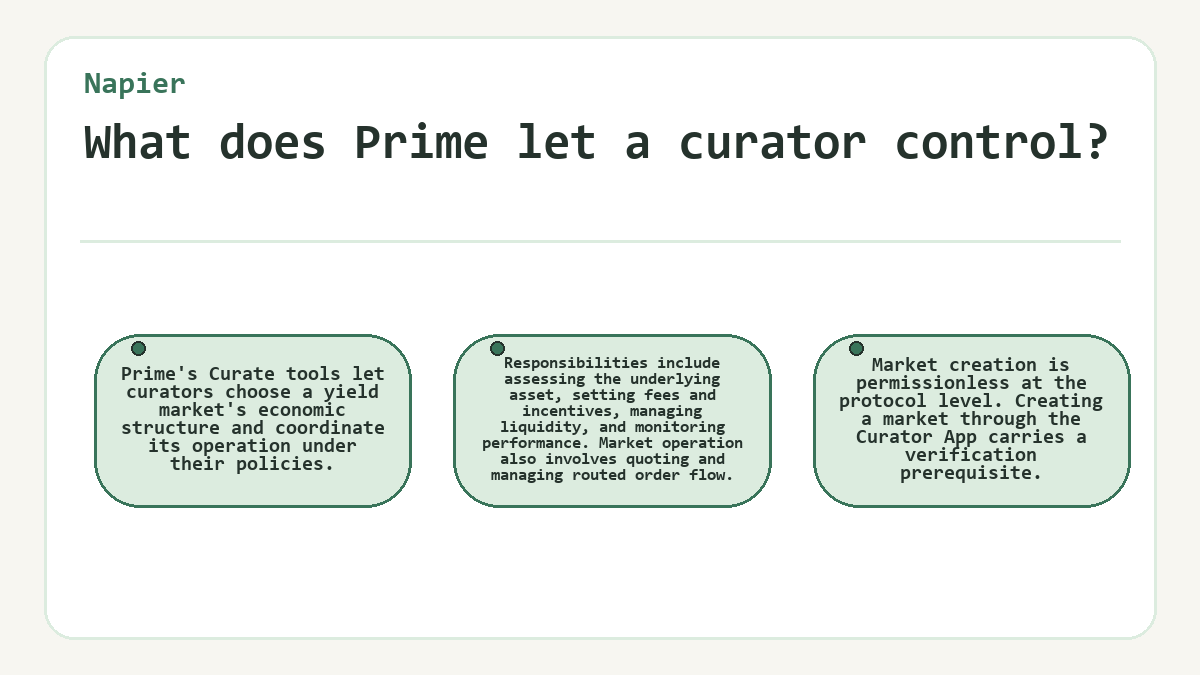
Prime's Curate tools let curators choose a yield market's economic structure and coordinate its operation under their policies. Responsibilities include assessing the underlying asset, setting fees and incentives, managing liquidity, and monitoring performance. Market operation also involves quoting and managing routed order flow. Market creation is permissionless at the protocol level. Creating a market through the Curator App carries a verification prerequisite.
Parameters and permissions
Curators select parameters for the asset and intended use, including maturity, fees, and applicable liquidity settings. Market parameters remain fixed after launch except where the design explicitly allows adjustments. Curators assign operating roles, including Fee Receiver and Protocol Pauser where configured. Market-level policies can also include identity checks and address whitelists. Access therefore follows the selected market's policy, while emergency actions follow its retained permissions.
Asset selection and ongoing operation
A resolver supplies the exchange rate between vault shares and their underlying assets. Resolver templates help curators connect supported yield-bearing assets without writing a new contract for every integration. Asset assessment includes the resolver and any oracle used for valuation. Markets involving external vaults require monitoring of those components and their allocation policies. Using PT or liquidity tokens as collateral also requires the receiving lending protocol's integration and pricing arrangements. The curator's chosen configuration determines which of these connections apply.
Infra connects market data and distribution
Infra provides programmatic market, token, and protocol information for applications integrating the platform. The API aggregates onchain and offchain information from indexing services, blockchain queries, and other data sources. Caching and periodic snapshots support data retrieval and historical analysis. Its coverage includes market analytics, token metadata, portfolio information, and curator operations. A unified query interface supports data access across multiple blockchains.
Developers and distributors can bring markets into wallets, exchanges, and financial applications, route orders directly or through aggregators, and connect liquidity from other systems. Asset issuers contribute eligible assets and support secondary liquidity and distribution. The destination market retains its own asset, maturity, and access rules, and assigned roles retain market administration.
Authenticated API endpoints use Sign-In with Ethereum and JSON Web Tokens. API authentication and curator-assigned market permissions govern different kinds of access.
Security controls and market exposure
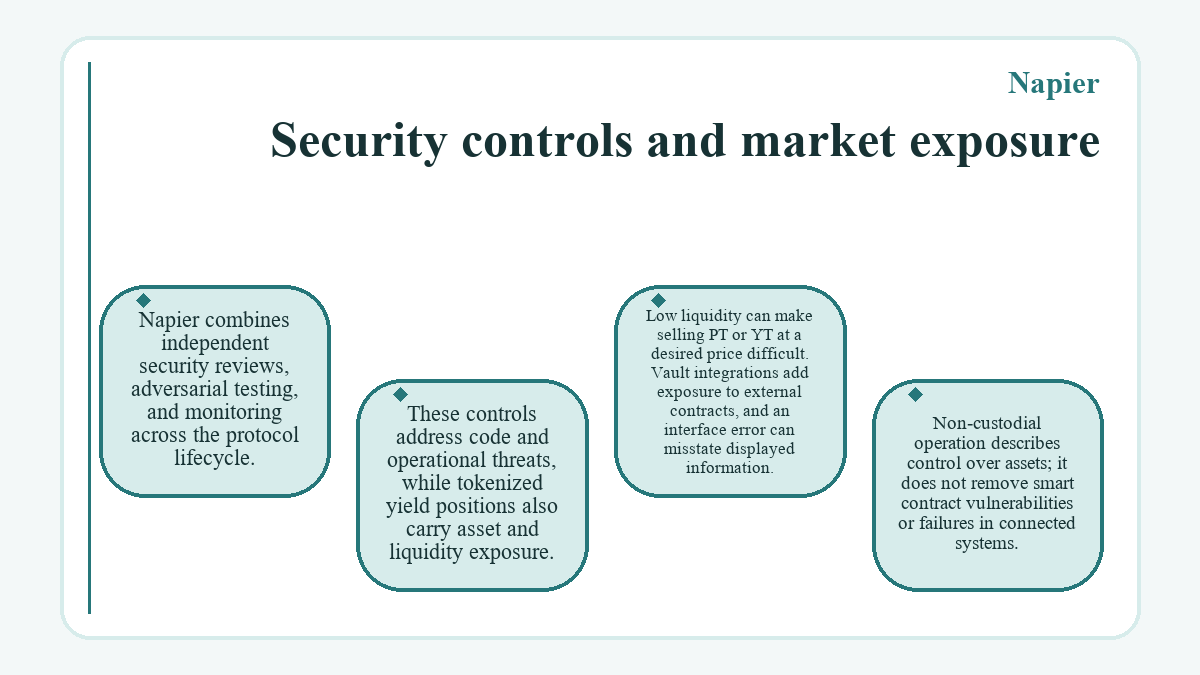
Napier combines independent security reviews, adversarial testing, and monitoring across the protocol lifecycle. These controls address code and operational threats, while tokenized yield positions also carry asset and liquidity exposure. Low liquidity can make selling PT or YT at a desired price difficult. Vault integrations add exposure to external contracts, and an interface error can misstate displayed information. Non-custodial operation describes control over assets; it does not remove smart contract vulnerabilities or failures in connected systems.
Which Napier tools are public and which are private?
Yield Trading, Curate, and API documentation have public entry points, while Global Fixed Income and the software development kit (SDK) carry private access labels. Global Fixed Income concerns infrastructure for tokenized fixed income, with an access status separate from the DeFi yield markets.
Napier announced public availability of TokiHook source code on October 13, 2026. The public implementation allows inspection of maturity-aware pricing and curator configuration. Access to source code remains separate from access to products carrying private labels.
- Choose Yield Trading when comparing PT and YT exposure in an available market.
- Evaluate Curate when the task includes selecting market parameters and assigning operating roles.
- Start with the API documentation when an integration needs programmatic market and token data.
- Treat Global Fixed Income as a private-access product when evaluating tokenized fixed income infrastructure.
- Plan SDK-dependent development around the SDK's private access status.
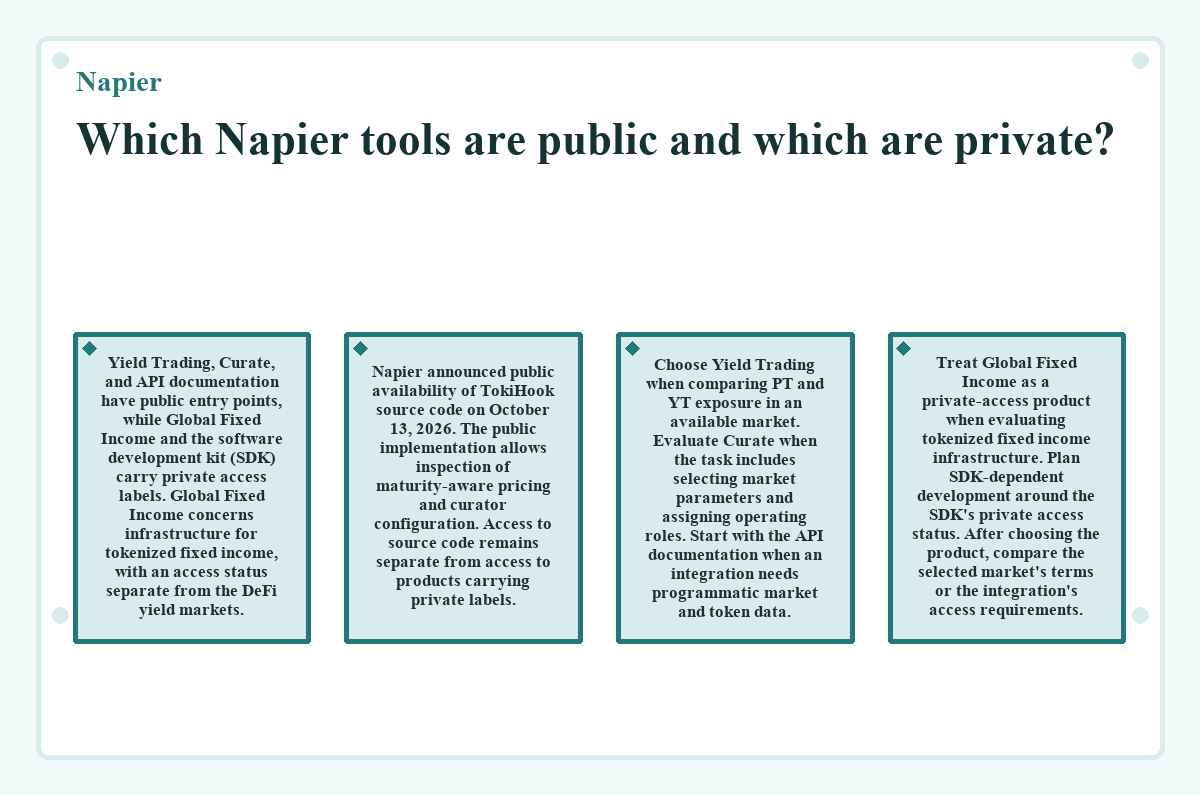
After choosing the product, compare the selected market's terms or the integration's access requirements.
Key questions about Napier
Who develops Napier and coordinates its contributors?
Napier Labs is the core developer of the protocol and interface, while the Napier Foundation coordinates major contributors. The Foundation is a Panama association supporting development and decentralization. Governance forms a separate part of the ecosystem, with the NPR token powering onchain and offchain protocol governance.
What does an Unstoppable badge mean for curator control?
An Unstoppable market is one where the curator has renounced all administrative permissions except Fee Receiver. This configuration makes the market immutable. The remaining role allows the designated recipient to collect curation fees. The badge describes market permissions, while asset performance and trading liquidity remain separate considerations.
Are partner points automatic for PT, YT, and liquidity positions?
Partner points depend on the asset issuer's program and its integration with the market. PT does not earn these points by itself; YT holders' point exposure comes from their share of underlying tokens held by the PT contract. A program operator may count the entire liquidity position or only its non-PT portion. Program operators must stop tracking points for a market at maturity, when YT stops accruing yield.
Can developers reuse TokiHook code without restrictions?
TokiHook reuse follows the applicable file licenses. Napier's October 13, 2026 code-publication announcement identifies BUSL-1.1 for Napier-authored contract files. Public access allows developers to inspect the implementation, while the relevant license terms govern how they may reuse it.
How do issuance, redemption, and performance fees differ?
Issuance fees charge a fixed percentage of the underlying used to mint PT and YT. Redemption fees charge a fixed percentage when converting PT, with associated YT where applicable, back into that underlying. Before maturity, performance fees apply to accrued yield, including points, across outstanding YT. After maturity, they apply to yield from the yield-bearing tokens backing matured, unredeemed PT. Curators set each market's fee schedule.