 Napier
 PT can serve as collateral in compatible lending markets
Napier Principal Tokens (PT) can serve as collateral when a lending market accepts the specific PT directly or through a supported collateral vault and uses a compatible price oracle. This connects a fixed-income position to borrowing in protocols such as Morpho or Euler. The lending market determines collateral valuation, borrowing limits, and interest terms. When enabled, rehypothecation lets the Napier automated market maker (AMM) allocate idle liquidity to external vaults. That allocation has separate settings and withdrawal dependencies.
Table of contents
PT, price oracles, and borrowing capacity
A PT-backed lending position combines the principal claim, a valuation mechanism, and the lending market's borrowing rules. The token supplies the collateral asset. The oracle gives the lender a usable valuation, while collateral limits determine how much debt the position can support. Holding PT establishes the asset exposure; the external integration establishes its borrowing use.
Each yield market connects PT to a particular yield-bearing asset and maturity. Those details matter when a lending market selects collateral, because support for one PT contract does not establish support for a token with another maturity or underlying, even when the token names look similar. The relevant contracts must also share the lending market's chain. A curator prepares the yield market and PT oracle before configuring the lending integration. A holder entering an already integrated market uses that market's borrowing conditions.
Collateral valuation before maturity
A PT oracle must value the fixed-term claim in a form the lending market can consume. The Napier AMM supplies PT price data for lending integrations. The AMM's maturity-aware design incorporates time to maturity and implied yields into pricing. The collateral integration also needs a complete pricing path for its loan asset or unit of account.
The pricing path needs consistent token units and decimal handling. In Morpho Blue, the oracle prices collateral against the loan asset. Euler's router can express collateral and liabilities in a configured unit of account. A PT price in one denomination does not automatically supply the valuation a different loan asset requires.
Lending configuration in Morpho Blue and Euler
Morpho Blue and Euler require lending-side configuration alongside the yield market and PT oracle. Their collateral structures use different components.
Morpho Blue market parameters
Morpho Blue pairs one collateral asset with one loan asset in each market. Market creation fixes the token addresses, oracle, interest rate model, and liquidation loan-to-value (LLTV). LLTV measures the maximum debt value relative to collateral value before liquidation eligibility. A PT integration therefore needs a market whose collateral address identifies the intended PT. The selected oracle must handle the relevant asset pair. An immutable market configuration can coexist with a changing borrowing rate or collateral valuation.
Euler vault relationships
Euler borrowers using PT deposit it into a collateral vault whose shares the loan vault accepts as collateral. Its Oracle Router connects accepted collateral and the loan vault's underlying asset to pricing. When a collateral vault is configured as resolved, the router converts its ERC-4626 shares into PT units before completing the pricing path. A vault share and the token inside it represent different units. The lending configuration must preserve that distinction when it values a PT-backed position.
Borrower collateral and AMM lending supply
Borrowing against PT and supplying AMM funds to a lending vault involve different positions. In the collateral use, the lending market accepts the token to secure debt. With rehypothecation, the AMM allocates part of its pool assets to selected external vaults, where yield on those allocations can supplement trading fees for liquidity providers while introducing dependence on the receiving vault. The native liquidity pools pair PT with its underlying asset, so allocation settings concern those pool holdings. A holder's personal PT collateral deposit does not specify where the AMM allocates liquidity.
Raw-token ratios and allocation locks
Rehypothecation settings determine which vaults receive pool assets and how much liquidity remains as raw tokens. The native AMM has allocation settings for PT and the underlying asset.
Balance allocation
Raw-token ratios
Minimum, maximum, and target ratios describe raw tokens relative to the total balance for the relevant pool asset. Raw tokens are balances the pool holds directly, outside the external vault. The percentages describe this raw-token share of the total balance, not the percentage the pool lends. Setting all three ratios to 100% keeps that allocation outside rehypothecation.
Vault selection
Vault selection identifies the destination for allocated PT or underlying tokens. Curators prepare supported receiving vaults before enabling allocations. Their choices shape the external protocol exposure the pool takes on, including asset availability when a trade needs liquidity.
Locked allocations
A rehypothecation lock prevents further changes to vault selection and allocation ratios. Curators can activate the lock after deployment.
Withdrawal availability and execution costs
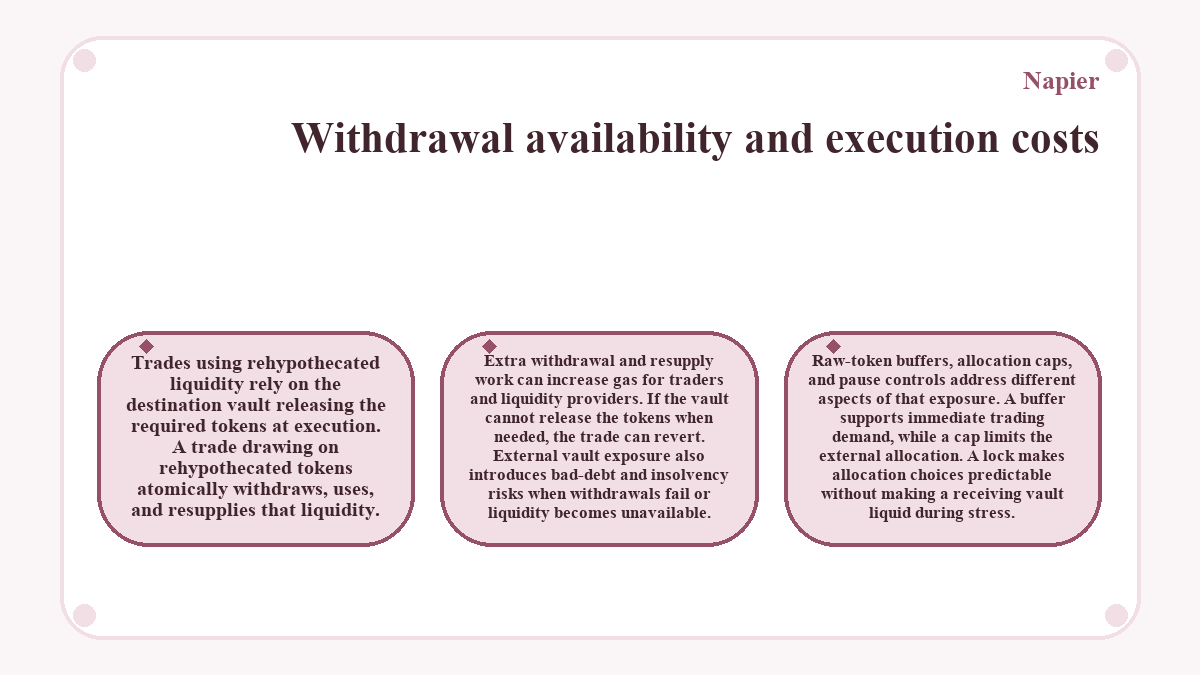
Trades using rehypothecated liquidity rely on the destination vault releasing the required tokens at execution. A trade drawing on rehypothecated tokens atomically withdraws, uses, and resupplies that liquidity. Extra withdrawal and resupply work can increase gas for traders and liquidity providers. If the vault cannot release the tokens when needed, the trade can revert.
External vault exposure also introduces bad-debt and insolvency risks when withdrawals fail or liquidity becomes unavailable. Raw-token buffers, allocation caps, and pause controls address different aspects of that exposure. A buffer supports immediate trading demand, while a cap limits the external allocation. A lock makes allocation choices predictable without making a receiving vault liquid during stress.
Can I borrow against any Napier PT?
A PT-backed loan requires a lending market which accepts the specific PT directly or through a supported collateral vault and uses a compatible valuation. A holder seeking predictable borrowing inputs can assess the position against these conditions:
- The collateral asset is the intended PT or shares of a vault holding it, on the lending market's chain.
- The lending configuration identifies the loan asset and applicable collateral limits, and available loan-asset liquidity covers the intended borrowing amount.
- The oracle returns prices in the units the lending market expects.
- The borrowing terms establish interest accrual and repayment conditions alongside PT maturity.
- If the associated AMM enables rehypothecation, its vault destinations and withdrawal conditions are clear.
Maturity, debt, and an early exit
A fixed-yield asset carries maturity terms; the borrowing position carries debt and the lending market's collateral requirements. In Morpho Blue, exceeding the market's LLTV makes a borrowing position eligible for liquidation. A PT-backed position can therefore face liquidation before maturity when its debt exceeds the permitted fraction of its collateral value. Underlying-protocol failures remain another source of loss for a collateral holder.
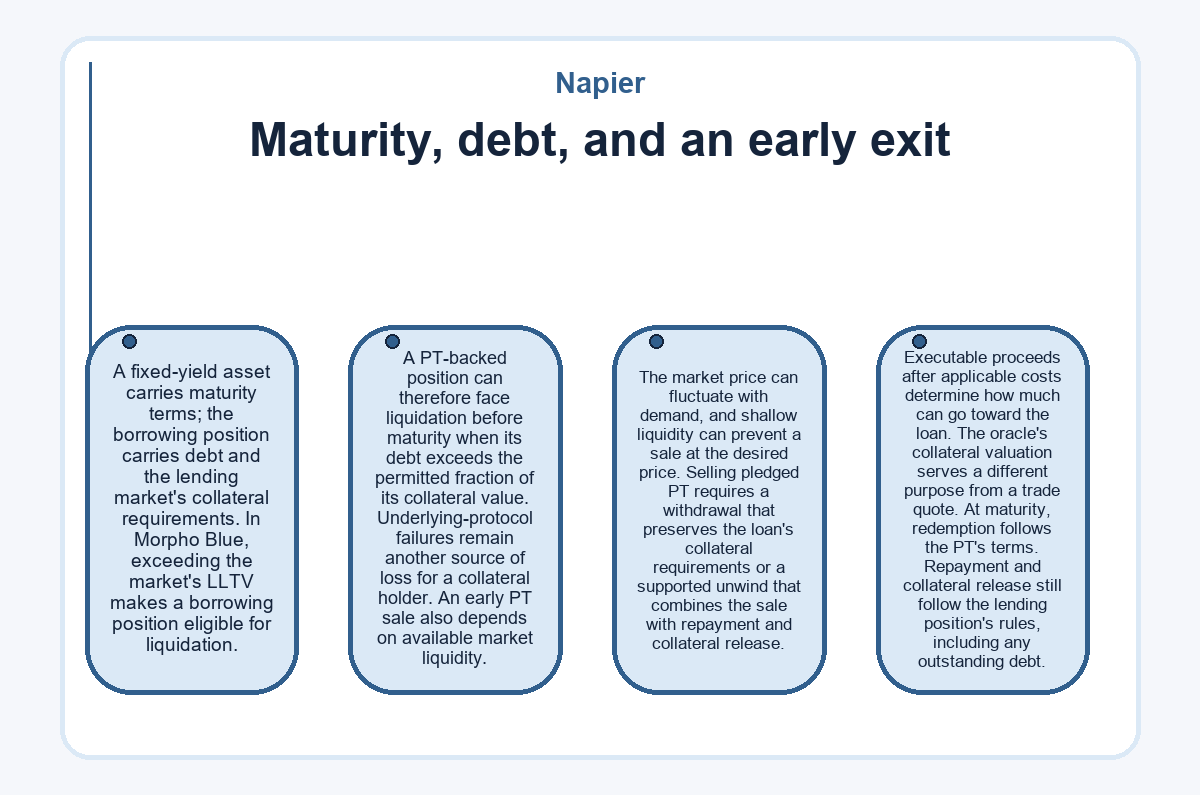
An early PT sale also depends on available market liquidity. The market price can fluctuate with demand, and shallow liquidity can prevent a sale at the desired price. Selling pledged PT requires a withdrawal that preserves the loan's collateral requirements or a supported unwind that combines the sale with repayment and collateral release. Executable proceeds after applicable costs determine how much can go toward the loan. The oracle's collateral valuation serves a different purpose from a trade quote.
At maturity, redemption follows the PT's terms. Repayment and collateral release still follow the lending position's rules, including any outstanding debt.
Reader questions
-
Can Napier LP tokens also qualify as lending collateral?
- A liquidity-provider (LP) token can qualify when a lending integration supports that token and its valuation. An LP token represents a pool position, so it needs its own collateral configuration and price oracle. Acceptance of the pool's PT does not automatically establish acceptance of its LP token. Morpho Blue uses a separate market configuration for each collateral asset.
-
Does PT collateral fix an Euler loan's interest rate?
- PT collateral does not itself fix an Euler loan's borrowing rate. The lending vault's configured interest rate model governs that rate. Where the model adjusts rates with utilization, borrowing costs can move while the collateral remains a fixed-yield position. The asset's yield and the loan's interest expense therefore enter separate calculations.
-
Can a Morpho Blue market switch to another PT oracle after deployment?
- A Morpho Blue market keeps the oracle address selected at creation. Its immutable market parameters prevent replacing that address after deployment. A different oracle address requires a separate market configuration.
-
Is curator verification the same as a PT borrowing permission?
- Curator verification and permission to borrow against PT govern different actions. The Curator App requires account verification before market creation. Borrower access follows the selected market's permissions and lending configuration. A verified curator account does not establish that a wallet can deposit collateral or borrow.
-
Will Uniswap v4 support automatically make my PT borrowable on another chain?
- Uniswap v4 compatibility does not automatically create a PT lending market on another chain. The native AMM's portable design concerns its deployment architecture. Collateral use additionally requires the relevant PT contracts, a compatible oracle, and a lending market on that network. Compatibility alone does not establish that those deployments exist.
-
Where do trade fees enter the cost of a PT-backed loan?
- A PT trade used to enter or unwind a borrowing position can add swap fees alongside borrowing costs. In the native AMM, swap fees use PT's yield-receivable portion as their base and the underlying token as their payment unit. Applying the fee percentage to the whole collateral balance would use the wrong base. Actual charges follow the selected market's settings.